Play responsibly
Forebet - Football Predictions, Statistics and Match Insights for Nigeria
Mathematical football predictions, form data and league statistics for Nigerian fans who prefer numbers over hunches.













Forebet gives football followers a practical way to study fixtures before kick-off. Its probability figures, recent form data and league statistics can help Nigerian users build a clearer picture of a match without relying on instinct alone.

What Is Forebet?
Forebet is a football analytics service that turns match history into probability figures. Instead of an opinion column telling you who should win, it presents a calculated chance of a home win, a draw and an away win, together with the information behind the estimate: recent results, goals scored and conceded, home and away records, and performances against comparable opposition.

The service covers hundreds of competitions, from major European leagues to second and third tiers that rarely receive television coverage in Nigeria. Beginners can use it as a quick check before watching a game, while regular users can compare several fixtures and investigate where the statistics differ from the general expectation around a match.
The figures are most useful when read in context. A high percentage does not remove uncertainty, and a low-profile league may provide less familiar information than a competition followed every week. Looking at the underlying form and scoring records helps explain why a forecast leans in one direction.
Why Forebet Is Popular in Nigeria
Nigerian football audiences follow the Premier League, the NPFL and continental competitions at the same time, often on a phone with a limited data plan. A page that combines fixtures and probabilities solves a practical problem: it reduces the need to make several separate statistical checks before a match.
The second reason is refresh frequency. Figures are recalculated as new results arrive, so form data from the weekend can be reflected in the midweek outlook. Anyone tracking the predictions for today can see how an unexpected result changes the context for the next round of games.

For a useful comparison, record the forecast before a match and then return to the result afterwards. This separates a sound probability estimate from hindsight and makes it easier to notice which competitions produce clearer patterns for your own analysis.
Understanding Mathematical Predictions
A mathematical prediction is a probability estimate, not a verdict. When a model gives the home side a 52 percent chance, it means that in a large sample of similar situations the home team wins slightly more often than not. The remaining probability belongs to the draw and away win, so a single result can easily go against the leading outcome.
The inputs are ordinary football facts, weighted by how recent and relevant they are:
- Form: results over the last several matches, with newer games generally carrying more weight.
- Goal averages: how many a team scores and concedes, separated into home and away records.
- Table position: an indication of the relative strength and season objectives of the two sides.
- Head-to-head history: useful context, particularly for established rivalries, but not a substitute for current form.
What the numbers cannot see is a late injury, a coach resting players before a cup tie, a suspension or a difficult journey. Weather, pitch conditions and an unusual tactical decision can also change a game. These limitations are especially relevant when a team has recently changed its coach or when a league has irregular scheduling.
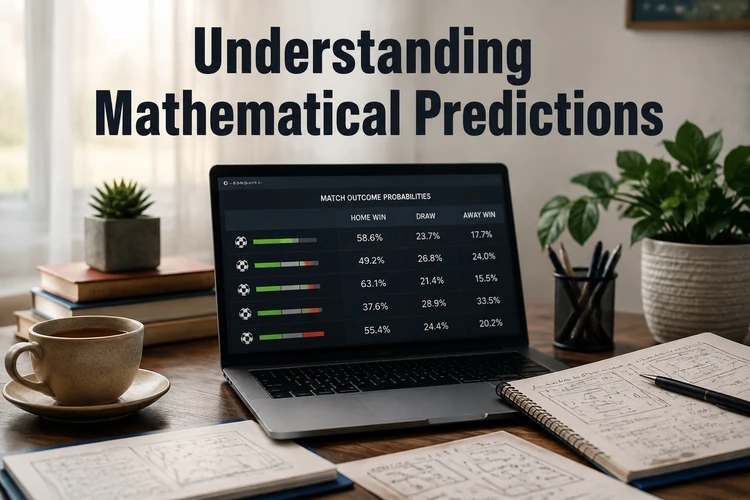
A sensible reading compares the probability with the evidence. Check whether the home advantage is supported by home results, whether recent opponents were strong or weak, and whether scoring patterns point to a close game. Treat the forecast as one research input rather than a promise about the final score.
Explore the Main Sections
The navigation is organised by time first and by competition second. Daily pages show what is scheduled, while statistical pages let you examine a single team, league or completed fixture.
Most sessions start with a day view and end on a detail page. If you want to plan ahead rather than react, the list of fixtures for tomorrow gives you time to compare several matches before kick-off.
| Section | What it gives you |
|---|---|
| Today | Fixtures for the current day with calculated probabilities |
| Tomorrow | The next day's card for planning ahead |
| Predictions | Probability breakdowns and estimated score patterns |
| Results | Final scores for reviewing previous forecasts |
| Statistics | League tables, scoring averages and home-away splits |
| Team form | A club's recent run of results and upcoming matches |
When reviewing a fixture, start with the outcome probabilities, then inspect goals for and against, recent home or away form and the position of both teams. Looking at the final score estimate last can prevent one attractive scoreline from overshadowing the broader evidence.
Football Competitions Available
Coverage spans domestic leagues, continental club competitions and national-team tournaments. Nigerian users often move between the English top flight, the NPFL and whichever African or European knockout round is being played that week.
Typical competitions include the English Premier League, the Nigeria Professional Football League, the UEFA Champions League, the Europa League and Conference League, Serie A, La Liga, the Bundesliga, Ligue 1, the CAF Champions League and international fixtures such as World Cup and Africa Cup of Nations qualifiers.
Lower divisions can also be worth examining, but they deserve extra care. Team news may be harder to find, line-ups can change quickly and a small sample of recent matches may distort the apparent form. Compare several indicators instead of judging a competition from one fixture.
Using the Site on Mobile
The mobile layout adapts the same service to a phone screen, with no separate download or account needed. Tables use narrower columns, and the date selector is positioned near the top so you can switch between days without returning to a desktop computer.
On a slow connection, load a day page once and read it before jumping between competitions; each new page creates another request. Landscape orientation can help when you want more of the probability table visible, while normal portrait view is usually quicker for scanning fixture names and times.
Small screens make comparison more difficult, so note the competition and kick-off time before opening another page. If a table looks compressed, rotate the phone rather than assuming that a column or percentage is missing.
How to Find Matches Quickly
Three routes get you to a specific fixture. Choose the one that matches what you already know about the game.
If you know the date, open the day view. If you know the competition, browse the competition listings and work down to the round you need. If you remember one club's name, use the available team search and open its form page to review upcoming and completed matches.
- Step 1: Choose the date or competition.
- Step 2: Open the fixture row to see the full probability breakdown.
- Step 3: Check both teams' recent form before drawing a conclusion.
For a past match, begin with the result and then compare the pre-match probabilities with what happened. For an upcoming match, check whether the latest available results have altered the form picture. This simple order keeps the research focused and avoids confusing completed fixtures with future ones.
Tips for Nigerian Users
Compare at least three fixtures before deciding which one you understand best. A match where the statistics and the table agree may be easier to interpret than one affected by injuries, rotation or a sudden change in form.
Watch the calendar too. A side playing a continental fixture midweek often rotates at the weekend, and no model can capture every selection decision in advance. Check the local kick-off time and revisit the page after significant team news.
Keep a short record of the factors you considered and the final result. Over time, this shows whether your conclusions are based on repeatable evidence or on memorable but unusual matches. Statistics are an analytical tool, never a guarantee of any outcome, and betting decisions remain entirely yours. If wagering stops being entertainment, read the guidance on responsible gambling. Content is intended for adults only, 18+.
FAQ
Forebet is a football statistics and prediction service. It calculates the probability of a home win, draw or away win for each fixture using historical results, goal averages, current form and home or away records. The output is a set of percentages, not a guaranteed tip.
The predictions, fixtures, results and league statistics are available without payment. You can read a day's fixtures, open individual matches and check team form without registering.
Accuracy varies by competition and by how predictable a league is. A probability of 60 percent still allows the outcome to fail roughly four times in ten. Assess the numbers over a long run rather than judging them by one weekend.
No account is required to read predictions, results or statistics. The main pages are open to visitors on desktop computers and mobile phones.
Figures are recalculated as new results arrive, so weekend matches can affect the outlook for midweek fixtures. Checking again closer to kick-off is useful after surprising results or significant team news.
Coverage includes the English Premier League, the Nigeria Professional Football League, UEFA club competitions, the main European leagues, the CAF Champions League and international qualifiers. Many second- and third-tier divisions are included as well.